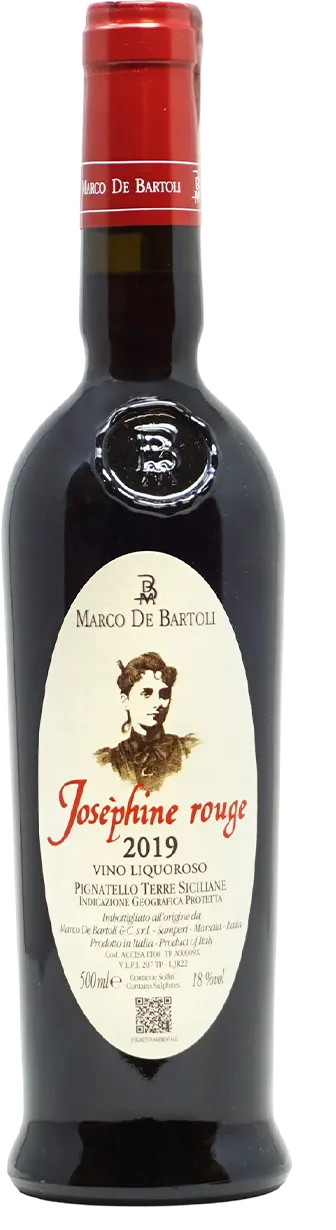
Joséphine Rouge is a sweet red wine from Pignatello, born from the synergy between the grape variety’s structure and a vinification process that preserves a natural portion of its sugars. Fermentation occurs on the skins and is subsequently arrested with the addition of wine spirit.
Aging in French oak guides the wine towards an intense, soft, and balanced profile, particularly suited for pairing with chocolate.
Western Sicily
18% vol.
1984
Planted in 1992
Hilly.
Training System: Guyot espalier; 3,800 vines per hectare.
Manual, from September 27 to 30.
Yield per hectare: 40 hl.
Fermentation in the presence of skins, with traditional punch-downs and pump-overs until color extraction. Subsequently, wine spirit is added to arrest fermentation and maintain a natural residual sugar.
30 months in 10 hl French oak barrels.
Number of bottles produced 6,280
Joséphine Rouge originates from a family story.
Joséphine De Spagne, a lady from Bordeaux and Marco De Bartoli’s great-grandmother, had a particular passion for chocolate mousse. According to the family’s oral tradition, she promised her love to whoever could find the wine capable of accompanying that dessert. The search was unsuccessful, and Joséphine withdrew her promise.
Eighty years later, Marco De Bartoli symbolically took up that challenge by creating Joséphine Rouge: a sweet red wine from Pignatello specifically conceived to complement chocolate.
The wine retains 54 g/l of residual sugar and a total acidity of 5.50 g/l, elements that contribute to the balance between sweetness, structure, and freshness.
It pairs particularly well with chocolate-based desserts and is ideal with dark chocolate. Serve slightly chilled, preferably in a tulip-shaped glass.
The estate is located in Contrada Samperi, twelve kilometers from Marsala, on calcareous and sandy soil that the Mediterranean wind sweeps across unimpeded. The baglio dates back to the late nineteenth century — thick walls, filtered light, the scent of aged wood already noticeable from outside. Around it, Grillo vineyards cultivated in the alberello system, as is the tradition of this land.
12 HA
medium-textured sandy-limestone, flat
alberello and Guyot-trained vertical shoot positioning; 3,500 vines per hectare.
manual in small crates, during the final weeks of September.
Manual selection of grapes, soft pressing, natural sedimentation, traditional fermentation in oak and chestnut barrels at room temperature.
Aging in oak and chestnut barrels with the addition of 5% younger wine each year, using the traditional perpetual method.
8.600