
1945–2011
He didn’t invent a new tradition. He sought out the one that had been forgotten.
In Samperi, he restored dignity to Marsala wine. In Pantelleria, he listened to the sun, the wind, and the island’s people. In between, there were Grillo, Zibibbo, car racing, and an unnegotiable conviction: a great wine must belong to the place from which it originates.

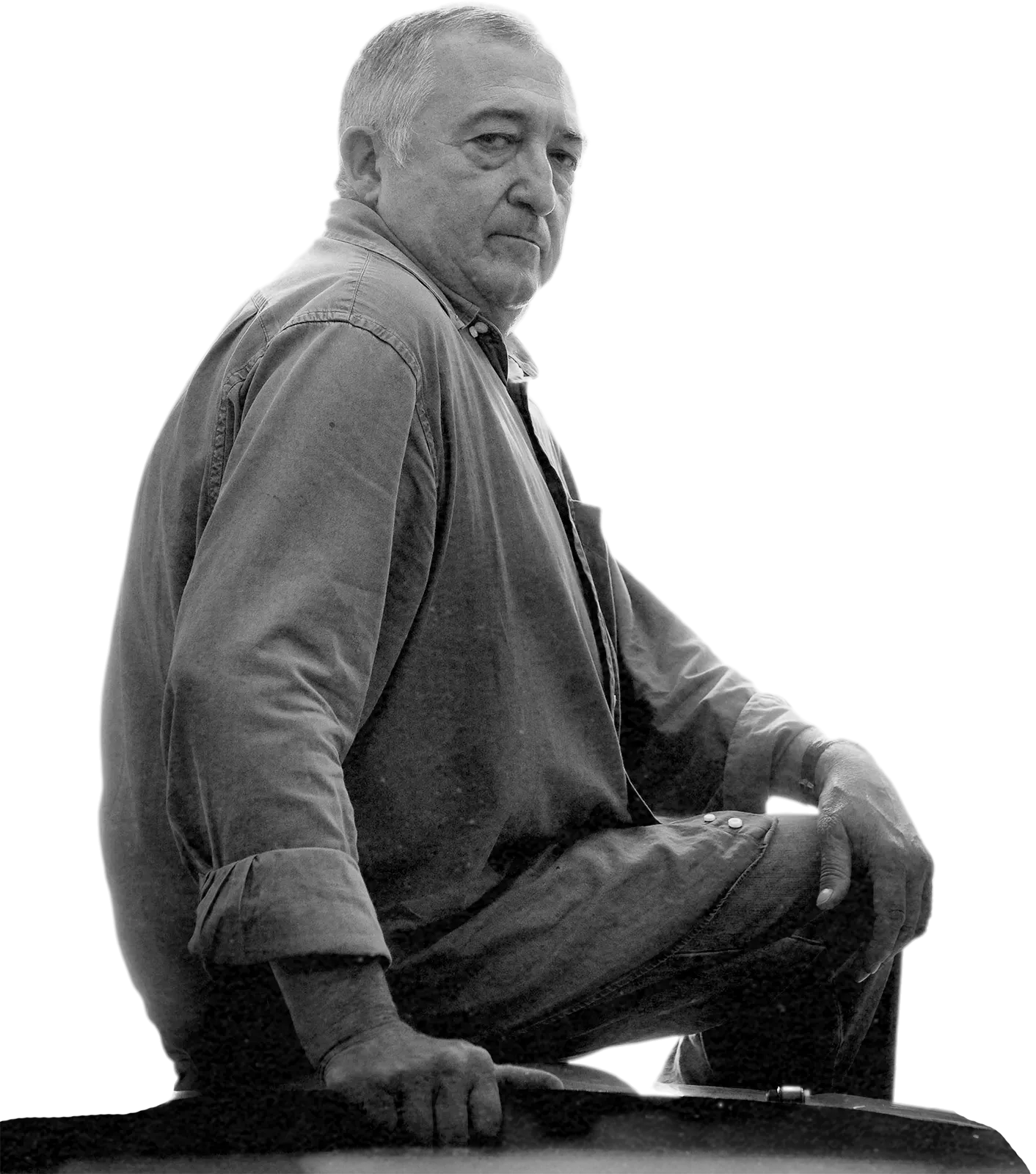
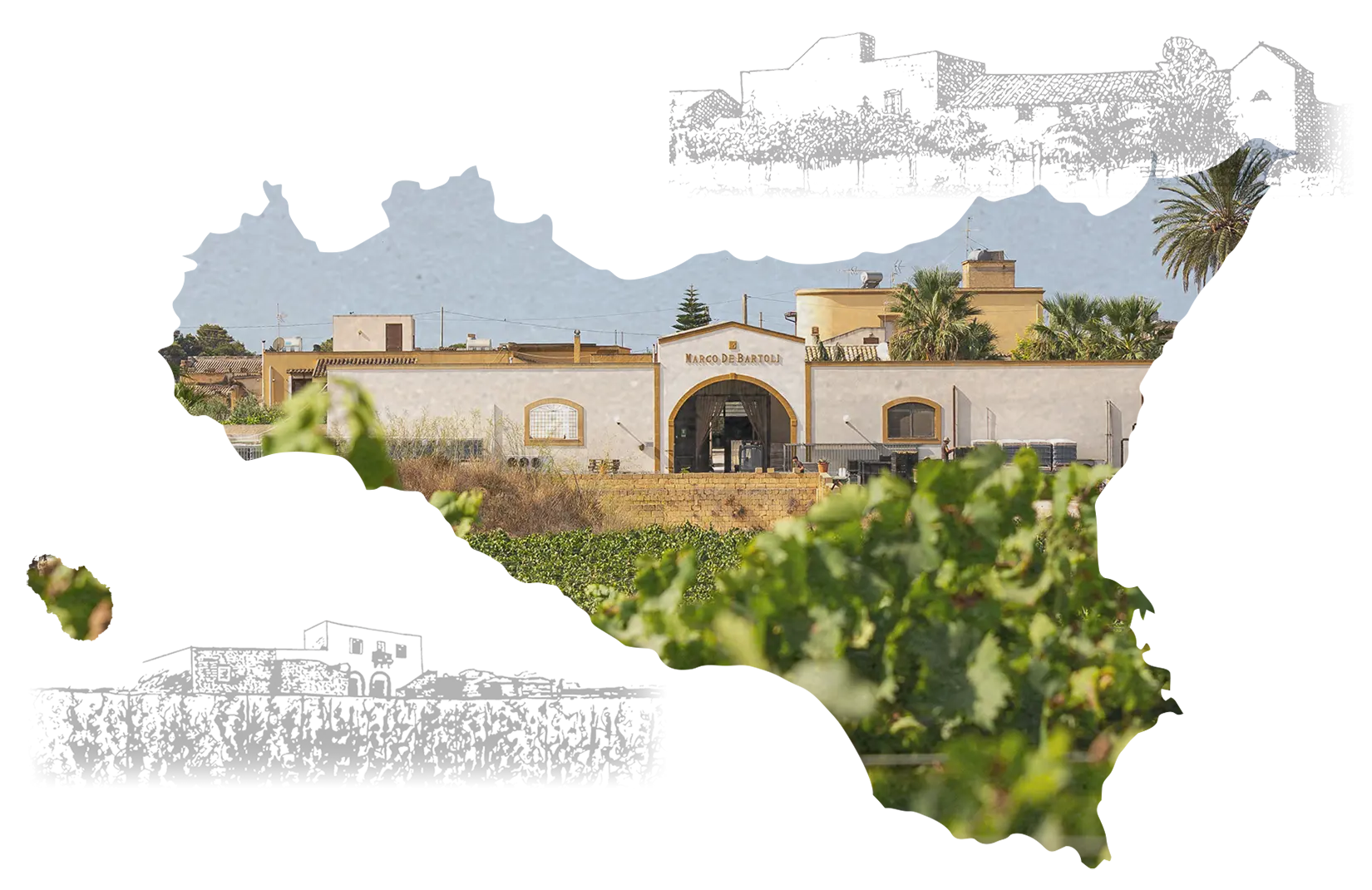
Samperi is located on the southwest coast of Marsala, a few kilometers from the sea. It is a flat, dry, calcareous land, swept by the wind and imbued with light.
When Marco decided to dedicate himself to his land, the name Marsala was known worldwide, but the wine bearing that name had lost much of its identity. Mass production, shortened aging, and excessive use of alcohol had caused the wine to lose the identity of the territory that had generated it, excluding Marsala from the global enological scene and relegating it to a cooking ingredient.
De Bartoli’s response was not to invent something new. It was to return to the origins: to the wine produced in Marsala before British intervention, before fortification, when time, wood, Grillo, and the Perpetuo Method were sufficient to build its character.
It’s not enological archaeology. It’s not nostalgia. It’s a contemporary choice: to remove what is superfluous to let the territory speak. At Baglio Vecchio Samperi, Marco thus began a journey that the company still defines today as a “return to the origins of Marsala.”
Marco De Bartoli did not speak of Marsala with the caution of public relations. He considered it technically dead: not because there were no producers or consumers, but because it often originated from intensive viticulture, from wines already weak to begin with, corrected with an excessive addition of alcohol and aged too briefly to remedy.
“Unfortunately, I feel beyond the DOC,” he said in one of his last interviews.
It was not a declaration of superiority, nor was it a provocation for its own sake. It was the realization that the wine Marco envisioned could not fit into existing classifications.
His vineyard was DOC. His thinking was deeply linked to the appellation and the history of Marsala. But the rules could not prevent him from seeking longer times, stronger wine bases, and a quality that did not depend on the amount of added alcohol.
From this awareness, Vecchio Samperi was born: the wine that Marsala could have continued to be if its history had not been simplified to make it cheaper to produce and easier to sell.
“Giving a wine a fantasy name is a defeat for the territory.”

Before being known as a winemaker, Marco De Bartoli was a racing driver. He raced during the seventies on circuits and roads that demanded courage, mechanical sensitivity, and the ability to push to the limit. He participated in the Targa Florio, the Coppa Florio, and various competitions reserved for sports prototype cars.
In 1977, paired with Pasquale Anastasio in an Osella, he finished second overall in the last Targa Florio held as a speed race. He continued to race until 1979, while another adventure was already beginning in Samperi.
For some time, Marco reconciled two opposing speeds.
On the track, he sought the exact braking point. In the cellar, he learned not to rush anything. Races were decided in a few seconds; perpetual wine required years, decades, generations.
When he left racing, that tension didn’t disappear. It merely changed pace.
Cars remained a living passion: he collected them, restored them, preserved their forms and memory. Engines also reappeared in the visual identity of the wines, as in the Giulietta Spider designed by Sebio De Bartoli on the label of Rosso di Marco.
In 1980, Marco bottled the first Vecchio Samperi.
The name is already a declaration of belonging. It doesn’t bear the producer’s surname and doesn’t seek a seductive market formula: it bears the name of the district where the wine is born.
For Marco, naming a wine means declaring to whom that wine truly belongs.
Vecchio Samperi is made from Grillo grapes and aged using the Perpetuo Method. The barrels are never completely emptied: each year, a portion of the older wine is drawn off, and the missing volume is topped up with younger wine.
The past is not replaced. It is nourished.
Each bottling thus contains a part of previous vintages: not a snapshot of a single year, but a living archive, continuously transformed by time.
Marco also traveled the territory in search of ancient perpetual wines stored in family baglios and cellars. Some of the recovered reserves dated back to the early decades of the twentieth century; wines dating back to 1903 are preserved in the company archives.
They were not relics to be displayed. They were fragments of an enological memory that risked disappearing.
“Variety is the genius of wine.”
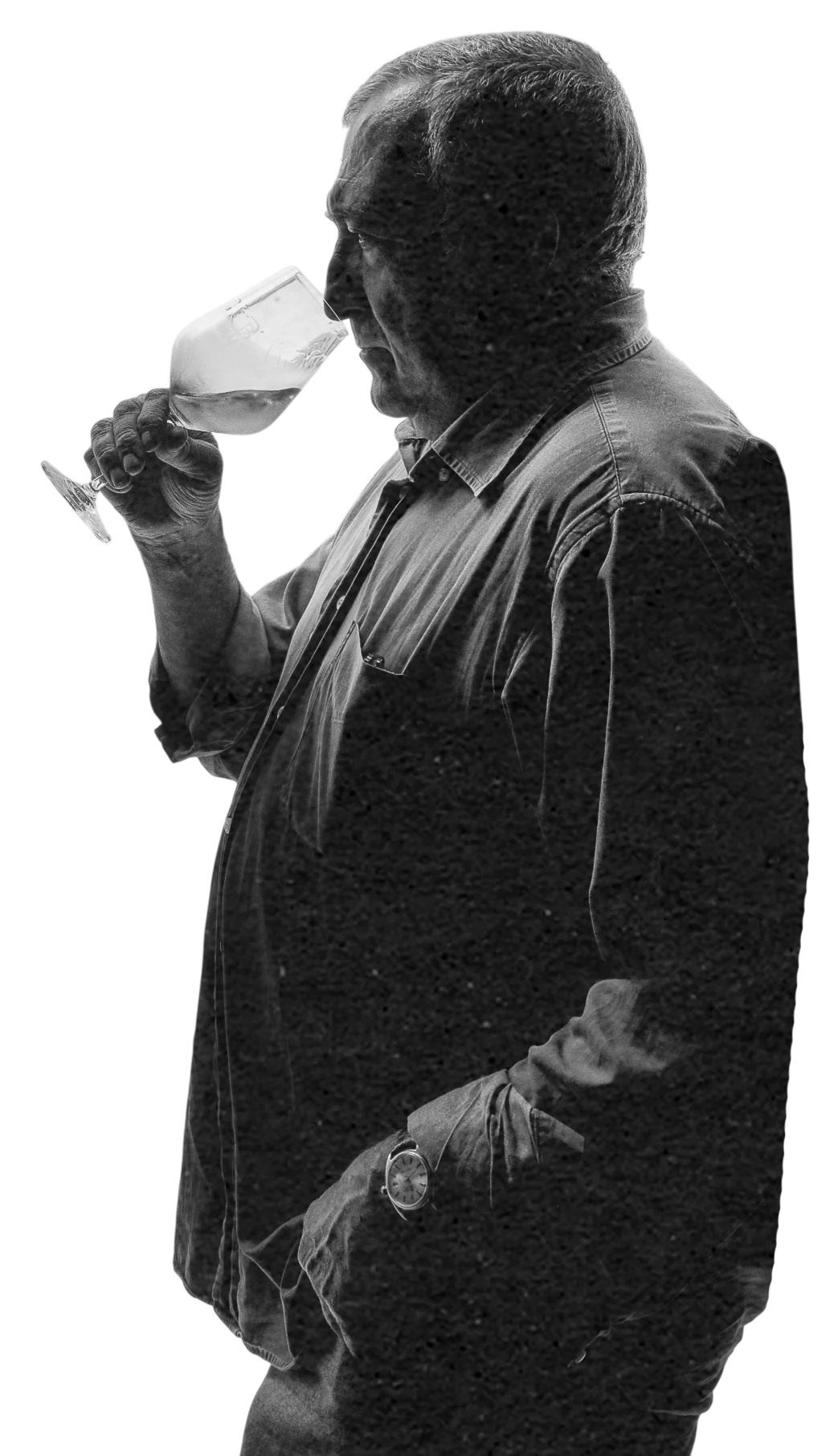
At the heart of Marco’s research was Grillo. He recognized its strength, acidity, ability to naturally reach high alcohol levels, and, above all, its aptitude for aging. In years when the grape variety was almost exclusively destined for oxidative wines and Marsala, De Bartoli understood its potential to also express itself as a great dry white wine.
In 1990, Grappoli del Grillo was born, the first pure white wine from Grillo grapes. New winemaking techniques brought to light what no one had yet sought in that grape variety: structure, body, complexity, and the ability to last over time. With that wine, Marco brought Grillo out of the role it had been assigned.
This is the same principle that guided all his work: not to import a model from another territory, but to discover how far what already exists in that place can go.
One land is not enough to contain Marco’s curiosity.
In the early eighties, he arrived in Pantelleria and was struck by the terroir and energy of the island: the lava stone, the wind, the terraces, the bush vines dug into hollows to protect them. He chose an already suitable area, discovered centuries earlier by the Arabs, who produced raisins from dried Zibibbo here, a southwest-facing plateau, among the earliest ripening areas on the island.
In Bukkuram, a name of Arabic origin translated as “father of the vineyard,” he listened to the older growers and studied the traditional method of drying grapes. Marco often repeated, during the harvest, that the essential element for his passito was the “August sun”: precisely the month in which, in Bukkuram, the grapes are left to dry. The cellar was built in an eighteenth-century dammuso; in 1984, the first Bukkuram passito was bottled.
But the same grape, cultivated in a more north-facing area, where nature is untamed and almost hostile, revealed another possibility to him. Thus, in 1989, Pietranera was born: for the first time ever, Zibibbo, vinified dry, brought out the aromatic and mineral notes of Pantelleria’s volcanic soil, a radically different version compared to the island’s typical production.
Even in Pantelleria, Marco did not want to impose a formula. He wanted to learn the language of the place. Samperi and Bukkuram thus became the two poles of his research: on one side Grillo, limestone, and the perpetual method; on the other, Zibibbo, capable of being both volcanic rock and sun-drying, dry and mineral or dense and concentrated.
Two islands within the same island. Two wineries united by the same idea: technique must serve the territory, not replace it.
A wine outside conventional categories needed an equally free image.
It was created by Carlo Lauricella, a contemporary artist and friend of Marco De Bartoli. He was not simply called upon to decorate a bottle, but to transform the world surrounding the founder into symbols: Samperi, the baglio, the land, cars, movement, irony.
In 1980, Lauricella designed the first label for Vecchio Samperi. In 1983, he created an image for an advertisement published in Sicilia Motori: a natural encounter between Marco’s two great passions, wine and racing. That work was revisited many years later for Vecchio Samperi Quarantennale.
Lauricella also drew the Baglio di Samperi in ink. The lines are essential, almost familiar. The baglio is not represented as a monument, but as what it is: a home, a workplace, the point from which everything originated.
The labels do not invent the character of Marco De Bartoli. They reveal what already existed.
“One sees clearly only with the heart.” A phrase, from The Little Prince, that Marco loved to repeat.
He was courageous, stubborn, intuitive. He could be uncomfortable, impetuous, incapable of softening an opinion just to make it more acceptable. He had no inferiority complexes towards great Italian or French producers: he thought of Sicilian wines on the same level, with pride and a competitive spirit.
But the rigor with which he approached ideas coexisted with a natural generosity towards people.
He loved the sea, cars, friends, work, wine, and food. Family memories describe him through simple dishes and everyday flavors: fried eggplant, egg meatballs, matarocco, peaches in wine.
At Samperi, they ate together. There was always the possibility of adding a chair, uncorking a bottle, transforming a visit into a lunch.
He was very harsh towards conventions he considered unjust. Towards people, however, he remained open until the last seat at the table was filled.
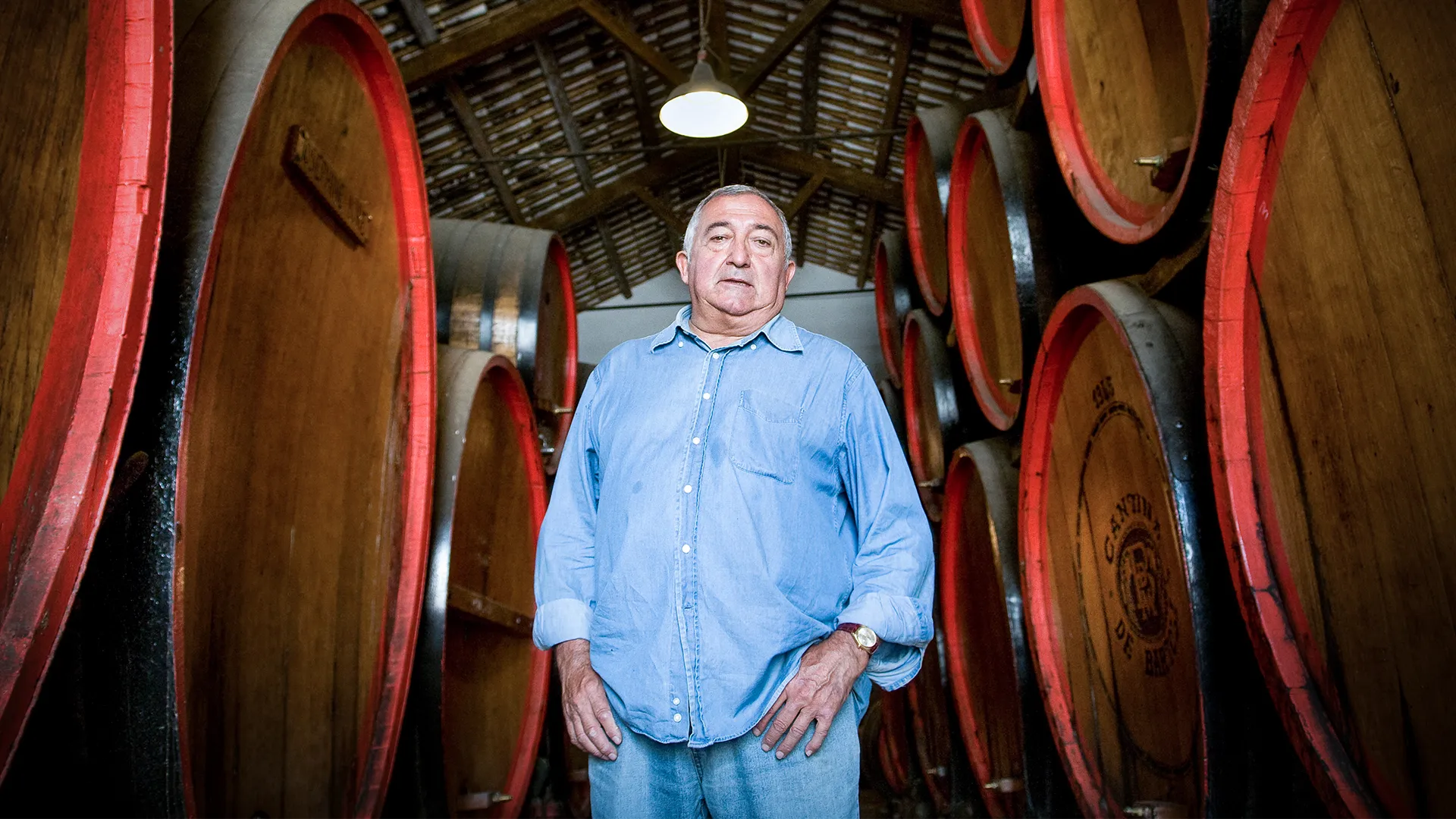
Marco De Bartoli died on March 18, 2011, at 66 years old.
He left behind wines that became benchmarks, two wineries, and above all, a way of understanding work: starting from native grape varieties, respecting time, defending the identity of places, and never confusing innovation with the erasure of memory.
His children Renato, Sebastiano, and Giuseppina took up their father’s project, continuing to develop it between Samperi and Pantelleria. Production has expanded, but the fundamental principle has remained recognizable.
Over the years, awards and recognitions have arrived. The Vecchio Samperi Perpetuo Quarantennale received 100 points from DoctorWine; Slow Wine awarded the winery the Snail and Vecchio Samperi the Top Wine recognition; Bibenda honored multiple company labels with Five Grappoli. But the recognition closest to Marco’s land came in December 2021, when Marsala named a square after him.
Not a score. Not a guide. Not an industry award. A city that chose to write his name among the places traversed every day, and for those who work the vineyard, a name still to follow.
Marco De Bartoli demonstrated that respecting a tradition does not mean repeating it. It means understanding it deeply enough to carry it into the future. Vecchio Samperi, the Marsalas, Grillo, and the Bukkuram wines continue to tell that vision: one family, two wineries, an irreducible bond with Sicily.
12 HA
medium-textured sandy-limestone, flat
alberello and Guyot-trained vertical shoot positioning; 3,500 vines per hectare.
manual in small crates, during the final weeks of September.
Manual selection of grapes, soft pressing, natural sedimentation, traditional fermentation in oak and chestnut barrels at room temperature.
Aging in oak and chestnut barrels with the addition of 5% younger wine each year, using the traditional perpetual method.
8.600